2026 Salesforce Job Market Update
Good News: Salesforce job postings have doubled from 14,000 (May 2024) to over 31,200 (September 2025) on major platforms.
Reality Check: Entry-level positions face increased competition, while senior architects and AI specialists are in high demand with premium salaries.
Key Trend: Agentforce and AI integration skills are becoming essential for career advancement in 2026.
Quick Answer (TL;DR)
What is a Salesforce job board? A specialized platform exclusively listing Salesforce positions—administrators, developers, architects, consultants—with salary transparency, certification tracking, and Salesforce-specific career resources unavailable on general job sites.
Average Salesforce salaries in 2026: Administrators $75K-$110K, Developers $95K-$135K, Architects $140K-$200K+, with remote positions offering competitive compensation.
Most in-demand roles: Technical Architects, Senior Developers (Apex/LWC), AI/Agentforce Specialists, Solution Architects, and Integration Experts commanding premium salaries.
The Salesforce ecosystem is experiencing a significant transformation in 2026. After the turbulent job market reset of 2023-2024, hiring is stabilizing with cautious optimism.
The market now demands more specialized skills, particularly in artificial intelligence, automation, and advanced technical architecture. For Salesforce professionals navigating this evolved landscape, a dedicated Salesforce job board has become essential for finding opportunities that match expertise and salary expectations.
This comprehensive guide reveals how Salesforce job boards work in 2026, which roles command the highest salaries, what certifications employers actually value, and proven strategies for landing competitive positions in an ecosystem that has shifted from "hiring everyone" to "hiring strategically."
What is a Salesforce Job Board?
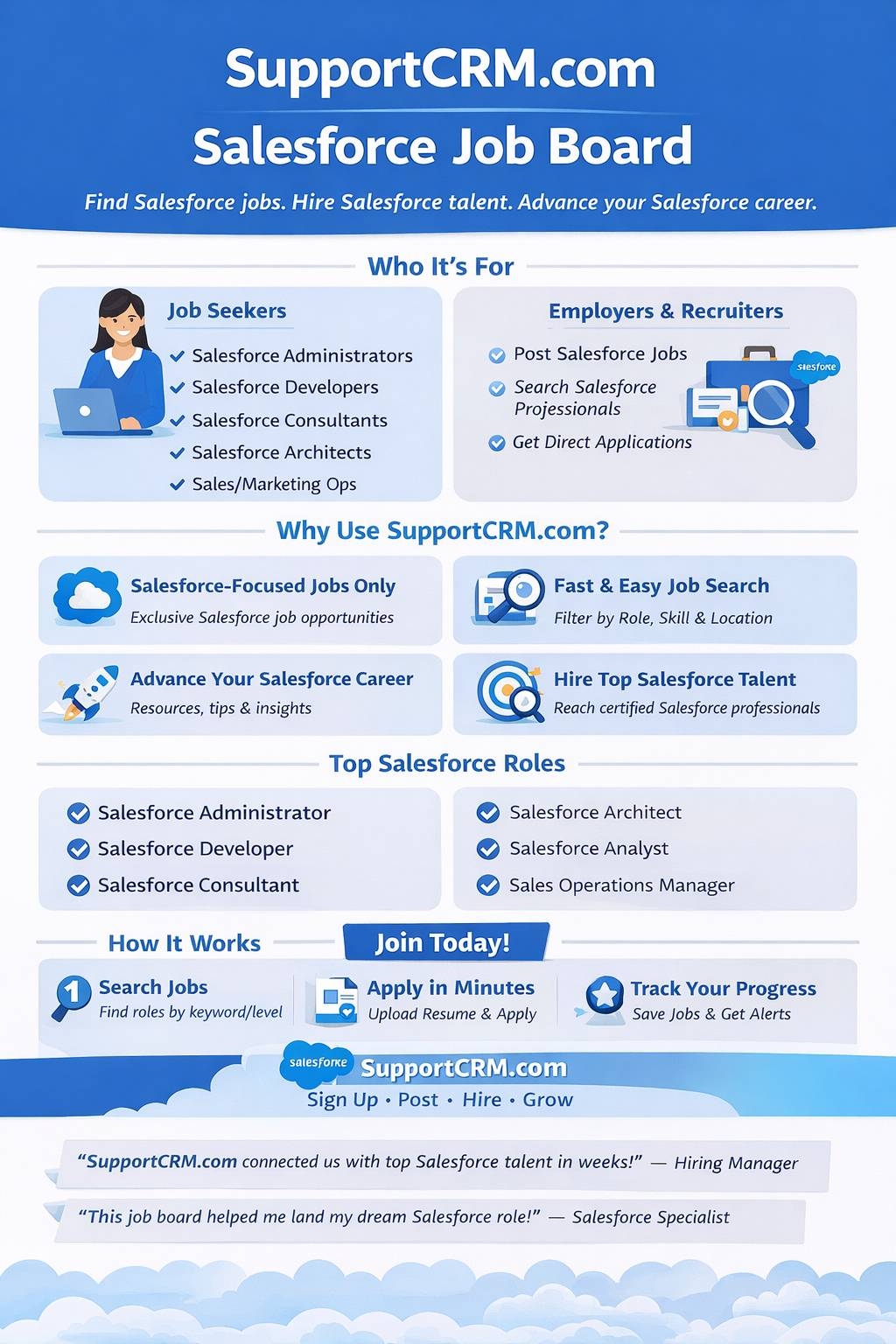
A Salesforce job board - SupportCRM.com with Applicant Tracking Software is an employment platform specifically designed for the Salesforce ecosystem. Unlike LinkedIn or Indeed, which mix thousands of job categories, a Salesforce job board exclusively features positions requiring Salesforce expertise—from entry-level administrators to technical architects earning $200,000+ annually.
These specialized platforms offer critical advantages for Salesforce professionals. They provide filtering by specific Salesforce clouds (Sales Cloud, Service Cloud, Marketing Cloud, etc.), certification requirements, programming languages (Apex, Lightning Web Components, JavaScript), implementation experience, and industry specialization. This precision saves countless hours compared to sifting through generic "CRM" or "tech" listings.
Critical Insight: With over 31,200 Salesforce job postings in the US alone (September 2025 data), the challenge is not finding listings but identifying which opportunities align with your skill level, certification status, and salary requirements. Specialized job boards solve this through advanced Salesforce-specific filtering that general platforms cannot match.
The best Salesforce job boards aggregate openings from direct employers, consulting firms (which now represent 20% year-over-year growth in the ecosystem), recruiting agencies specializing in Salesforce talent, and exclusive partnerships with Salesforce ISV partners. This comprehensive reach ensures you access opportunities before they flood general job sites.
Salesforce Job Market by the Numbers (2026)
- 31,200+ Active Salesforce Job Postings (US)
- $98,862 Average Salesforce Professional Salary
- 9.3M Projected Ecosystem Jobs by 2026
- 20% YoY Growth in Consulting Partners
Understanding the 2026 Salesforce Job Market Reality
The Salesforce job market has matured significantly from the "gold rush" years of 2020-2022. Here is what every job seeker needs to understand about current market dynamics:
Market Stabilization After the Reset
Following substantial layoffs in 2023 and hiring freezes through 2024, the market has entered a stabilization phase. Job postings have nearly doubled year-over-year, but employer expectations have simultaneously increased. Companies no longer hire based solely on certifications; they demand demonstrable project experience, business acumen, and increasingly, AI integration capabilities.
According to recent ecosystem surveys, 87% of Salesforce professionals report the job market feels more challenging than during the pandemic boom. However, this reflects market normalization rather than decline. The unrealistic hiring frenzy of 2020-2022 created unsustainable expectations that the 2026 market has corrected.
Entry-Level Saturation vs. Senior Shortage
A critical bifurcation has emerged in the Salesforce talent market. Entry-level administrator positions face significant competition, with hiring managers reporting that filling junior roles now takes several months as they evaluate numerous qualified candidates. The supply of newly certified professionals has grown 31% year-over-year, creating this saturation.
Reality Check for Entry-Level Candidates: Simply obtaining a Salesforce Administrator certification no longer guarantees immediate employment. You need additional differentiators: hands-on experience through freelance projects, specialized cloud knowledge, programming skills, or industry-specific expertise (healthcare, financial services, manufacturing). The most successful entry-level candidates demonstrate practical application of their knowledge, not just certification badges.
Conversely, senior technical talent remains scarce. Companies actively compete for experienced architects, senior developers capable of complex implementations, and specialists in emerging areas like Agentforce and AI integration. These roles command premium compensation and often include sign-on bonuses, equity, and generous remote work arrangements.
Highest-Paying Salesforce Roles in 2026
Salesforce career paths offer exceptional earning potential, but compensation varies dramatically by role, experience level, specialization, and geographic location. Here are the positions commanding top salaries in the current market:
 Salesforce Technical Architect
Salary: $140K - $200K+
Designs enterprise-scale Salesforce solutions, data architecture, and complex integrations. Requires 8+ years experience, multiple certifications, and proven ability to lead technical implementations. Highest demand with shortest time-to-hire.
 Senior Salesforce Developer
Salary: $120K - $155K
Expert in Apex, Lightning Web Components, and complex customizations. Must demonstrate clean code practices, performance optimization, and ability to mentor junior developers. Particularly valuable with JavaScript framework experience.
 Salesforce Solution Architect
Salary: $130K - $175K
Bridges business requirements and technical implementation for large-scale projects. Requires deep understanding of multiple Salesforce clouds, integration patterns, and ability to communicate with C-level executives.
 AI/Agentforce Specialist
Salary: $125K - $180K
Emerging role focused on implementing and optimizing Salesforce's Agentforce AI platform. Combines Salesforce expertise with AI/ML knowledge, data science fundamentals, and prompt engineering skills. Extreme demand with limited supply.
 Salesforce Integration Specialist
Salary: $110K - $145K
Expert in connecting Salesforce with external systems via APIs, middleware, and integration platforms. Must understand RESTful services, authentication protocols, and enterprise integration patterns. Growing demand as companies consolidate tech stacks.
 Salesforce Business Analyst
Salary: $85K - $120K
Translates business needs into Salesforce solutions, documents requirements, and manages stakeholder expectations. Recent data shows 5% salary decline over 18 months, but demand remains strong for experienced analysts with industry expertise.
 Salesforce Administrator
Salary: $75K - $110K
Manages daily Salesforce operations, user administration, security, and declarative customizations. Entry-level positions face highest competition, but experienced admins with specialized cloud knowledge (CPQ, Field Service) command premium salaries.
 Salesforce Consultant
Salary: $100K - $145K
Advises clients on Salesforce strategy, leads implementations, and drives adoption. Consulting firms showing 20% YoY partner growth create abundant opportunities, especially for consultants with multi-cloud and change management expertise.
Salary Trends and Geographic Considerations
Recent salary survey data reveals nuanced compensation trends. While some roles have experienced minor salary decreases (administrators down 4%, developers down 4%, business analysts down 5% over 18 months), this reflects market correction from unsustainable pandemic-era compensation rather than long-term decline.
Geographic location significantly impacts earnings. The highest-paying markets include San Francisco Bay Area, New York City, Boston, Seattle, and Washington DC. However, the normalization of remote work has created opportunities for professionals in lower cost-of-living areas to access competitive salaries previously available only in expensive metros.
Remote Work Reality: Approximately 50% of Salesforce professionals maintain fully remote arrangements, with another 40% in hybrid models. However, recent data suggests office-based workers receive pay increases more frequently than remote employees, potentially indicating companies view remote work as a compensatory benefit. This trend merits monitoring as return-to-office mandates evolve.
Essential Salesforce Certifications That Actually Matter
The Salesforce certification landscape contains over 40 credentials, but not all carry equal weight with employers. Understanding which certifications provide genuine career value versus those offering marginal benefits saves time and examination fees.
Foundation Certifications (Required for Entry)
These certifications serve as minimum requirements for most Salesforce positions:
- Administrator
- Platform App Builder
- Platform Developer I
The Administrator certification remains the universal entry point, required for virtually all Salesforce roles. Recent updates emphasize Agentforce capabilities, reflecting industry evolution toward AI integration.
Advanced Certifications (Career Accelerators)
These credentials significantly differentiate candidates and justify premium salaries:
- Platform Developer II
- Application Architect
- System Architect
- Technical Architect
- Marketing Cloud Developer
Platform Developer II and architect-level certifications correlate strongly with six-figure salaries and shortened job search timelines. The Technical Architect certification, requiring rigorous review board assessment, represents the pinnacle of Salesforce technical credentials.
Emerging Certifications (2026 Demand Drivers)
These newer credentials align with current market trends:
- Agentforce Specialist (New!)
- AI Associate
- Data Cloud Consultant
- OmniStudio Developer
The newly launched Agentforce Specialist certification addresses the market's shift toward AI-powered CRM. Early adopters of this credential position themselves advantageously for the emerging wave of AI implementation projects expected throughout 2026.
The Certification Paradox
While certifications remain important, recent ecosystem discussions reveal a nuanced reality. Multiple professionals report that excessive certification accumulation without corresponding project experience actually reduces hiring appeal. Employers prefer candidates with 3-5 strategically chosen certifications backed by demonstrated implementation experience over those displaying 15+ certifications with limited practical application.
| Certification Count | Employer Perception | Optimal Strategy |
|---|---|---|
| 0-1 Certifications | Insufficient for most roles | Obtain Administrator + 1 specialized cert minimum |
| 2-5 Certifications | Strong foundation, demonstrates commitment | Ideal range when paired with project experience |
| 6-10 Certifications | Impressive expertise in specialized areas | Valuable for senior roles and consulting positions |
| 11+ Certifications | Diminishing returns without experience | Focus on implementation work, not more certifications |
Critical Skills Beyond Certifications
The 2026 Salesforce job market demands skills that extend well beyond passing certification exams. Employers increasingly evaluate candidates on holistic capabilities that determine project success:
Technical Skills in Highest Demand
Apex Development: Complex trigger logic, asynchronous processing, governor limit optimization
Lightning Web Components: Modern JavaScript, reactive patterns, component lifecycle mastery
Flow Builder Excellence: Advanced automation, screen flows, integration patterns, error handling
Integration Architecture: REST/SOAP APIs, middleware platforms, authentication protocols, event-driven architecture
Data Management: Data modeling, large data volumes, data quality, ETL processes
AI & Agentforce: Prompt engineering, Einstein features, AI model configuration, agentic workflows
Business & Soft Skills That Differentiate
Technical proficiency alone no longer suffices. The most successful Salesforce professionals possess these critical soft skills:
Stakeholder Management: Ability to communicate complex technical concepts to non-technical executives, manage expectations, and navigate organizational politics effectively.
Business Process Understanding: Deep comprehension of sales, service, and marketing operations enables translating business requirements into optimal technical solutions rather than simply implementing what stakeholders request.
Change Management: Salesforce implementations fail not from technical issues but from user adoption challenges. Professionals who drive organizational change and user engagement provide exponentially more value than those focused purely on configuration.
Industry Specialization: Healthcare, financial services, manufacturing, and nonprofit sectors have unique Salesforce requirements. Industry-specific expertise creates competitive advantage and justifies premium compensation.
How to Use a Salesforce Job Board Strategically
Maximizing a Salesforce job board's value requires a strategic approach beyond passive job browsing. Here are proven tactics employed by successful job seekers:
Create a Compelling, Searchable Profile
Most Salesforce job boards allow creating profiles that recruiters actively search. Optimize your profile with these elements:
Certification badges prominently displayed: List all certifications with acquisition dates, demonstrating continuous learning trajectory.
Keyword-rich skills section: Include specific technical terms recruiters search for—"Apex triggers," "Lightning Web Components," "CPQ implementation," "Marketing Cloud Journey Builder," etc.
Quantified achievements: Replace vague statements like "improved processes" with specific metrics: "Reduced case resolution time by 35% through custom Service Cloud automation," or "Implemented CPQ solution supporting $50M annual quote volume."
Project portfolio: If permitted, include links to GitHub repositories, Trailhead profile, or documented case studies demonstrating your work quality.
Configure Intelligent, Multi-Layered Alerts
Set up multiple job alerts with varying specificity rather than one broad alert:
Primary alert: Your exact role, desired salary range, preferred location/remote status, and required certifications.
Growth alert: Positions slightly above your current level, helping identify when you become qualified for advancement.
Lateral alert: Adjacent roles (e.g., if you are a developer, alert for technical architect positions) to understand career progression pathways.
Emergency alert: Extremely broad parameters as backup if primary searches yield insufficient results.
Timing Your Job Search Strategically
Salesforce hiring follows seasonal patterns. Budget cycles typically drive increased hiring in January-March and September-October as companies begin new fiscal years and quarters. Summer months (June-August) generally see reduced activity, though exceptions exist for urgent backfills.
Additionally, major Salesforce events—Dreamforce (October), TrailblazerDX (varies)—often precede hiring surges as companies get energized about new platform capabilities requiring skilled implementation.
Research Companies Thoroughly Before Applying
Quality applications trump quantity. Before submitting applications, research:
Company's Salesforce maturity: Greenfield implementations offer different experiences than optimizing mature orgs. Align opportunities with your career goals.
Tech stack and integrations: Understanding which systems integrate with Salesforce reveals the technical complexity and learning opportunities.
Team structure: Small teams offer broad exposure but potentially limited mentorship. Large teams provide specialization and advancement paths.
Reviews from current employees: Platforms like Glassdoor reveal insights about work culture, management quality, and work-life balance that job descriptions omit.
Remote vs. Hybrid vs. Office: The 2026 Reality
The Salesforce ecosystem's remote work landscape has stabilized after years of flux. Understanding current trends helps set realistic expectations and negotiate effectively:
Approximately 50% of Salesforce professionals work fully remote, 40% in hybrid arrangements, and only 10% fully office-based. However, recent salary data suggests a complex dynamic emerging: office-based workers report receiving pay increases more frequently than remote counterparts.
This trend potentially indicates employers treating remote work as a benefit with monetary value, effectively offering lower base salaries in exchange for location flexibility. Whether this represents temporary adjustment or permanent shift requires monitoring throughout 2026.
Negotiating Remote Arrangements
For professionals prioritizing remote work, these strategies improve negotiation success:
Demonstrate proven remote productivity: Quantify accomplishments from previous remote roles, emphasizing self-management and async communication skills.
Offer hybrid compromise: Willingness to travel quarterly for team meetings or annual events reduces employer concerns about remote arrangements.
Address time zone proactively: If located far from company headquarters, explain your schedule flexibility and overlap hours with the core team.
Request remote trial period: If employers resist permanent remote work, propose a 3-6 month remote trial with objective performance metrics.
Consulting vs. In-House: Choosing Your Career Path
Salesforce professionals face a fundamental career decision: working in-house for a single organization or joining a consulting firm implementing Salesforce for multiple clients. Each path offers distinct advantages and challenges:
In-House Salesforce Roles
Advantages: Deep organizational knowledge, predictable schedule, established relationships, long-term strategic thinking, typically better work-life balance, and opportunity to see sustained impact of your work.
Challenges: Limited exposure to different implementations, potentially slower career growth, possible organizational politics, and risk of skill stagnation if org uses limited Salesforce functionality.
Ideal for: Professionals valuing stability, those with families requiring consistent schedules, individuals who enjoy becoming subject matter experts in specific business domains.
Salesforce Consulting
Advantages: Rapid skill development through diverse projects, exposure to multiple industries and implementations, faster career advancement, higher earning potential, extensive professional network, and constant learning.
Challenges: Demanding travel schedules (though reduced post-pandemic), pressure to generate billable hours, constant context switching between clients, and potential burnout from sustained intensity.
Ideal for: Early-career professionals maximizing learning, those energized by variety and challenge, individuals comfortable with ambiguity, and professionals prioritizing rapid advancement over stability.
Current Market Reality: Salesforce consulting partner ecosystem grew 20% year-over-year, now totaling nearly 3,000 partners. This growth creates abundant consulting opportunities, especially as companies prefer engaging consultants for specific projects rather than expanding permanent headcount. Consulting experience also provides exceptional resume credentials for later transitioning to high-level in-house roles.
The Future: Agentforce and AI's Impact on Salesforce Careers
Artificial intelligence represents the defining trend reshaping Salesforce careers in 2026 and beyond. Understanding AI's trajectory helps professionals position themselves strategically:
Agentforce: Salesforce's AI Revolution
Salesforce's Agentforce platform—autonomous AI agents handling customer service, sales processes, and operational tasks—fundamentally changes what Salesforce professionals do. Rather than eliminating jobs, Agentforce is creating new roles focused on designing, implementing, managing, and optimizing AI-driven workflows.
Early 2026 observations suggest Agentforce adoption will determine whether the Salesforce ecosystem experiences significant growth. Companies successfully implementing Agentforce will require professionals who understand:
Prompt engineering: Crafting effective instructions for AI agents to achieve desired outcomes.
AI governance: Establishing guardrails ensuring AI agents operate within ethical and legal boundaries.
Agentic workflow design: Mapping business processes suitable for AI automation versus those requiring human judgment.
AI performance optimization: Monitoring, measuring, and improving AI agent effectiveness over time.
What AI Won't Replace
Certain Salesforce capabilities remain firmly in human domain despite AI advancement:
Complex problem-solving: Novel business challenges requiring creative, multi-dimensional thinking.
Stakeholder relationship management: Building trust, managing organizational politics, understanding unspoken concerns.
Ethical decision-making: Determining appropriate use of customer data, balancing efficiency against privacy.
Strategic architecture: Designing enterprise-scale solutions requiring judgment about long-term implications.
Upskilling for the AI Era
Salesforce professionals should immediately begin developing AI-adjacent skills: basic understanding of machine learning concepts, data science fundamentals, experience with predictive analytics, familiarity with natural language processing, and comfort discussing AI capabilities and limitations with business stakeholders.
The Agentforce Specialist certification provides structured learning path, but practical experimentation with Einstein features, Flow automation, and AI-powered tools offers equally valuable experience.
Frequently Asked Questions About Salesforce Job Boards
How long does it take to find a Salesforce job in 2026?
Job search duration varies dramatically by experience level and market conditions. Recent survey data indicates approximately 25% of professionals take 3-6 months to land their next role, particularly at entry and mid-level. Senior technical positions (architects, senior developers) often receive offers within weeks due to talent shortage. To expedite your search: maintain active profiles on multiple Salesforce job boards, network consistently through Trailblazer Community groups, consider contract-to-hire positions as foot-in-the-door opportunities, and be willing to start with slightly lower-level roles to gain employment quickly.
Should I focus on Salesforce or learn multiple CRM platforms?
For most professionals, deep Salesforce specialization yields better career outcomes than broad multi-platform knowledge. The Salesforce ecosystem's size creates sufficient opportunities for specialists. However, understanding competing platforms (Microsoft Dynamics, Oracle CRM, HubSpot) at conceptual level enhances your ability to articulate Salesforce's advantages during sales cycles and provides career insurance if market dynamics shift. Senior consultants and architects benefit from multi-platform awareness, while developers and administrators should prioritize deep Salesforce expertise.
Is the Salesforce job market oversaturated?
The market shows nuanced saturation. Entry-level administrator positions face significant competition as certification supply has grown 31% year-over-year. However, senior technical roles (architects, senior developers, AI specialists) experience talent shortages with multiple competing offers common. The perception of oversaturation often reflects entry-level candidates competing for limited junior positions. Professionals with 3+ years experience, multiple certifications, and specialized skills (integration, specific clouds, industry expertise) find abundant opportunities. The market requires more than basic administrator certification to stand out.
Can I transition into Salesforce from a non-technical background?
Absolutely. Many successful Salesforce professionals began in sales, customer service, project management, or other business roles. The administrator career path particularly suits non-technical backgrounds since it emphasizes configuration over coding. Start with Salesforce Administrator certification, leverage free Trailhead learning, volunteer to be your current company's "Salesforce champion," complete hands-on projects in free Developer Edition orgs, and consider bootcamps or apprenticeship programs designed for career changers. Your business acumen combined with Salesforce technical skills creates valuable hybrid expertise many companies seek.
Do Salesforce professionals need computer science degrees?
No formal computer science degree is required for most Salesforce careers. Many top-earning professionals have non-technical educational backgrounds. Certifications, demonstrable skills, and project experience matter far more than degrees. However, developer and architect roles benefit from programming fundamentals typically taught in CS programs—but these can be self-taught or learned through bootcamps. Focus on building genuine Salesforce skills and portfolio rather than pursuing formal degrees specifically for Salesforce career entry.
What's the best way to gain experience without a Salesforce job?
Several proven strategies for gaining experience: (1) Volunteer through Salesforce.org Pro Bono program with nonprofits needing Salesforce assistance, (2) Freelance on platforms like Upwork starting with small projects, (3) Become your current employer's unofficial Salesforce expert, (4) Build practice projects in Developer Edition orgs documenting them on GitHub/portfolio site, (5) Join Trailblazer Community groups and volunteer to help others with questions, (6) Complete Superbadges proving hands-on problem-solving ability, (7) Create blog posts or videos explaining Salesforce concepts demonstrating your knowledge.
Find Your Next Salesforce Career Today
Join thousands of Salesforce professionals who have discovered their ideal positions through SupportCRM.com—the specialized Salesforce job board powered by ejobsitesoftware.com - Job Board Software , connecting talent with top companies actively hiring administrators, developers, architects, and consultants.
Take Action Now:
What Makes SupportCRM Different:
✓ 145+ Active Salesforce Positions Updated Daily
✓ Salary Transparency on All Listings
✓ Filter by Certification Requirements & Experience Level
✓ Direct Contact with Hiring Managers
✓ Free Career Resources & Interview Prep Guides
✓ Remote, Hybrid & On-site Opportunities Nationwide
For Employers:
Post your Salesforce positions and access our network of 5,000+ certified professionals actively seeking opportunities.
About This Resource
This guide incorporates data from industry-leading Salesforce salary surveys, ecosystem reports, and direct market observations from recruiting professionals specializing in Salesforce talent. Information reflects January 2026 market conditions with statistics verified from multiple authoritative sources including Salesforce Ben salary surveys, IDC ecosystem forecasts, and Glassdoor compensation data. We update this resource quarterly to maintain accuracy as the dynamic Salesforce job market evolves.